Thursday, September 21, 2006

An Unforbidden City

Yesterday's posting described Orange County, China, a residential development that replicates an American suburb. In fairness to the Chinese, I should also point out that a team of environmental designers from Berkeley has recently proposed a far more sustainable form of development which, if adopted, bodes well for the future of China and could provide a model for other places. The full story is found in Unforbidden Cities, by Harrison Fraker, Jr.

The proposed community includes
  • a stronger emphasis on public transit and non-polluting forms of transport like bicycles;
  • community development centered around public transit stops; and
  • most important and exciting, extensive use of renewable energy and recycling to make the community as self-sufficient and carbon-neutral as possible.
The central discovery in this project was the potential of "whole system design":
As the project progressed, the Berkeley team became more and more excited by the potential for the whole system design concept to be a real breakthrough, to be a reproducible model for sustainable development throughout China and the developing world. The buildings are platforms for producing energy from renewable sources such as wind and sun. Sewage is not treated and dumped, but processed into energy, fertilizer, and water for irrigation. The landscape is more than eye pleasing; it is a multi-functional contributor to the systems. There is little or no waste, and all energy is generated on site. Most importantly, the neighborhood becomes essentially a self-sufficient unit, a circular system. It does not require the construction of expensive new power plants, new sewage treatment and water supply outside the system.
This approach to community development, however, had its downside as well.
The new design requires a radical transformation in the development process. In addition to constructing housing units, the developer has to build a comprehensive, on-site utility system of energy production, water supply, and sewage treatment, which is beyond the developer's traditional scope of work. It requires getting approvals through government agencies that are narrowly proscribed and not accustomed to thinking across their jurisdictions. Most importantly, it requires design and construction professionals to share responsibility and to work collaboratively, to which they are unaccustomed. It requires paying 15 to 20 percent of the costs up front. Even though the life cycle costs are significantly less than the cost of constructing new centralized utilities, the question becomes: Who owns, operates, and maintains the system, and how are they compensated for the service? Some models exist for funding and operating on site systems, but none is as comprehensive and integrated as the one proposed.
Despite these potential problems, the Fraker team's approach offers an alternative for community design—not just in China and the developing world, but in the advanced economies. It will be interesting to see whether it is widely adopted in China.

Tuesday, September 19, 2006

Suburbia as Theme Park

The suburbs have become controversial in the United States. Critics point to their many downsides: they create sprawl, use land unwisely, and are almost completely dependent on private cars and cheap gasoline for liveability. They are not really neighborhoods because the houses are too far apart and the shops are miles away in shopping centers and big box stores.

Defenders of the suburbs point to their popularity—an argument which is undeniably true but beside the point. In a world of climate change and limited resources, we can't forever expand, build on farmland, and drive everywhere. And we have to start putting essential services within walking distance of where we live. Already many communities have passed anti-sprawl ordnances, and Portland, Oregon, has become the first major city to make a serious effort to control sprawl. Very gradually, we are relearning the value of cities and the importance of open countryside. Too gradually, some would say—but we are learning. And the automobile-driven suburb is less and less the solution and more and part of the problem. It is, at least, losing some of its cachet.

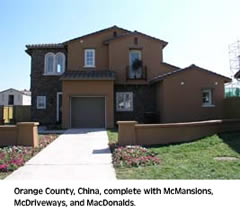
Not so in China, where new residents recently celebrated the opening of Orange County, an almost perfect replica of a U.S. MacSuburb. In one of the most crowded countries on earth, the houses sprawl over enormous lots. In a country that is already seeing pollution numbers skyrocket, residents will be entirely dependent on cars to get around.

These are nice houses, considered individually. But as a development, Orange County looks pretty disheartening to an outside observer. It is precisely the sort of community that we can't afford any longer, in many ways.

In fairness to the Chinese, Orange County is a kind of theme park: like previous developments that replicated English and French villages, it is a copy of a "typical" American neighborhood. But the differences between Orange County and an English village are palpable and telling.

An English village, for all its faults, is a genuine community. It has neighborhood gathering places; people actually know each other, sometimes in more detail than is entirely comfortable; and you can walk to the shops.

An American MacSuburb, by contrast, is a collection of houses on big plots of land. The neighborhood gathering place is likely to be the mall; people may or may not know each other—in fact, may not see each other on weekdays at all; and the shops are miles away in the neighborhood mall and big box stores.

To an outside observer, a place like Orange County seems more a curiousity than a threat. It is far less dangerous than the Chinese passion for the automobile and the Chinese commitment to coal-fired electricity generation. But it's sad that, when Orange County's developer was seeking the typically American, he or she settled on a subdivision full of expensive MacMansions. That says a lot, and none of it very good, about the American way of life.

Wednesday, September 13, 2006

A Creative Idea from England

One proposal to control greenhouse gas emissions—individual carbon ration cards—is already part of the public discussion in England. New Statesman environmental writer Mark Lynas suggests that, as a kind of domestic cap-and-trade system, carbon cards should appeal both to the left and to the right: to the left, because they should help cut carbon emissions without hurting the poor as much as increased fuel taxes; to the right, because they could create a free market in carbon points while controlling emissions. Polly Toynbee, writing in the Guardian, suggests that carbon cards for transportation could be implemented quickly, although carbon cards for overall fuel usage (e.g., for heating and cooking) would take longer to set up.

The idea is simple and could probably be administered through the tax system:
  • Each household would receive a fair share of carbon ration points, based on an overall carbon emissions goal for the country.
  • In the early stages of the program, points would be used for transportation—fuel for cars would use up so many points per gallon, fuel for trains so many points per mile, and so on for all transportation that used fossil fuels.
  • Families and individuals could use their carbon cards to track their own usage and how many points remained in their accounts.
  • If a family needed additional carbon points, it could purchase them, either from families who did not need them, or, probably at a higher cost, from the carbon rationing authority.
  • If a family did not need all its carbon points, it could either sell the excess to other families or receive a tax refund in exchange for the unused points.
Rationing has a bad name both in England and in other places, and especially in the United States. But carbon rationing on this model would be less problematic in many ways than proposals like high fuel taxes.

Fuel taxes, which are designed to increase fuel prices and discourage consumption, have two major flaws:
  • Any tax which is high enough to cause drivers to cut back seriously is politically doomed. Drivers vote, and groups like English truck drivers, who effectively killed a fuel tax proposal from the Blair government a couple of years ago, organize and demonstrate against tax proposals; and
  • Any tax which is high enough to cut fuel consumption is likely to hurt low-income drivers the most.
Carbon rationing avoids the second of these problems. By careful use of their share, low-income families might even make money from rationing (so could high-income families if they wished). Carbon cards would reward fuel users for efficiency, not punish them for buying the fuel they do use.

As to the politics of carbon cards, the situation would not be simple. No one likes to be told that there are limits to their ability to do what they wish. But in fact, in the future, there will be limits. The central question is not whether limits will exist, but how to implement them. Carbon cards are one idea that is worth considering.

Thursday, August 31, 2006

The Greening and Non-Greening of England

A month in England puts a lot in perspective. The government's Iraq policy and the threat from British-born Islamist fanatics get most of the press in the United States, along with the future ot Tony Blair, which is very much in doubt—as is the future of his Labour Party.

For me, however, the question of Britain and climate change, which gets little coverage in the U.S., was far more interesting than the fate of Tony Blair. In the United States, climate change still appears to be controversial—not among scientists and those who understand the issue, to be sure, but among politicians in Washington. In Britain, there is no such controversy. Blair's government is publicly committed to making Britain a leader in curbing greenhouse gases, and the public seems to agree. His recent agreement with California on a carbon cap-and-trade arrangement was almost universally applauded in the United Kingdom. Even his critics thought it was a good idea, although with misgivings.

Those misgivings were well-founded. Critics like Mark Lynas of the New Statesman point out that the UK has the worst recycling rate in Europe; that the Blair government has in fact spent more on highway construction than on improving railroads and mass transit; and that greenhouse gas emissions from the British transportation sector have actually risen in the past five years.

A tourist can't really confirm any of this, but some changes are noticeable.
  • There are more big box stores, and an article in the Guardian business section confirms that the Blair government is encouraging this type of development because big boxes are more "efficient." (Economically, perhaps, but not for the environment.)
  • Automobile traffic is noticeably up in the English Lake District even though it is easier and less frustrating to leave the car at home and take the train (but see below). Everybody drives to the Lakes, and by the smell test, the air quality in the more popular towns is not what it was. Everywhere we went, not just in the Lakes, there seemed to be more traffic than last year.
  • Trains are overcrowded and often do not run on time. The overcrowding is good, in a way, because it means that people are using the trains. But it is bad because it makes the trains less attractive as an alternative to the private car.
  • The number of cheap package tours to holiday spots has increased dramatically. Air fares included in these packages are sometimes effectively zero, and are generally lower than similar fares in the U.S.
None of this is good for the environment in general, or greenhouse gas production in particular, and much of it is the result of government policies. Blair's commitment to controlling greenhouse gases, at the moment, seems chiefly rhetorical.

But the greening of England is not wholly an illusion. Blair's rhetoric may or may not be hollow, but outside the government there is a lot of ferment—a more-informed public discussion than in the U.S.; a number of good ideas, both old and new; and a growing interest in alternatives like green buildings and walkable shopping districts. These are encouraging. They will be the subject of future postings.

Friday, July 28, 2006

The Good Life

Our religious and philosophical traditions, both Eastern and Western, have a lot to say about the good life. Not one of them suggests that to live it we need 200-horsepower cars, big-box discount stores, 20-room mansions on three-acre lots, Olympic-quality swimming pools on our land, and closets and basements and recreation rooms and back yards and attics and garages full of stuff.

For much Eastern tradition, the good life is about enlightenment—about freeing oneself, by powerful spiritual discipline, from the suffering that is the common lot of humanity. This does not necessarily mean a retreat into individual meditation. Eastern spirituality has produced great leaders like Gandhi and the Dahlai Lama whose concern for social justice and human dignity is (or was) clear in everything they did. But there is nothing in Eastern tradition that identifies justice or dignity—and hence the good life—with the accumulation of stuff or driving 100 mph on the open road. The prevailing ideology of economic growth is foreign to Eastern tradition.

In the West, where the prevailing ideology got its start, religion and philosophy are united in speaking against it. The Old Testament prophets emphasized justice and mercy to the poor, and they pointed out that riches could be a barrier, not a bridge, to the good life. Christianity's founder took a similar position, even teaching that riches not only could be but were a barrier to the Kingdom of Heaven. Islam to this day emphasizes concern for the poor, social justice, and spiritual discipline over accumulation of stuff.

Western ethical thinkers sought the good life in qualities as diverse as moderation, self-realization, obedience to conscience, and social justice—among others. Western philosophy even on occasion (as in the teachings of the Stoics) taught a discipline of self-denial that rivaled that of Christian and Buddhist monks. A determined reader might find some support for our prevailing ideology of growth in Jeremy Bentham's Utilitarianism, but this would be wrong. Bentham was concerned chiefly, though somewhat eccentrically and wrongheadedly, with social justice and reform. Nowhere in Western philosophy do you find support for the notion that virtue and happiness are identical with more and more stuff and faster and faster cars. Philosophers, East and West, seem as certain on this point as their religious counterparts.

How, then, did we come to identify the good life with constant economic growth? The answer is deceptively simple: the ideology of economic growth, with its accompanying economic structure, produced prosperity as no previous ideology or structure had. What it could not do was to control its own excesses. For that, we need to turn to our older and wiser traditions. They do not necessarily tell us to give up all the good things we have, but they point out that happiness does not reside in things alone. Enough food and shelter are preconditions for happiness and the good life—hence the emphasis in our traditions on mitigating or eliminating involuntary poverty. But we attain the good life by living well—by loving our neighbors and our families, being good citizens, and doing our work to the best of our ability—not by getting and spending alone.

In a future where growth will be limited by finite supplies of natural resources, the increased cost for extracting and processing them, and the need to cut greenhouse gases, that is good news. The economy cannot grow forever, but this is not the end of the world or of civilization. It is a new challenge. Our religious and philosophical traditions, if we understand them rightly, can help us to meet it.

Monday, July 24, 2006

Changing Separately and Together

I grew up in a tradition, liberal Quakerism, that puts great emphasis on individual action for good causes. Quakers often focus on changes in personal behavior, in part because our own behavior is within our control. The actions of policy makers, governments, corporations, and even other individuals are subject only indirectly to our control or even influence. We can try to persuade policy makers, and we can buy only morally-acceptable products, but in the end, our voice is small and weak compared to the forces arrayed against us. Our example may persuade, and if it does not, at least we did what was available to us.

As on other issues, so, it may seem, with climate change. We may or may not transform the world, but we can transform ourselves. We can choose to insulate our houses, thereby using less fuel to heat and cool them, for example. We can turn off lights. We can drive less or not at all. And so forth.

The problem is that, in this case, individual behavior changes not only won't, but can't, do the job. If everyone who worries about climate change cut his or her greenhouse gas emissions back to 28% of what they are now—a figure that climate scientists say we have to reach by 2050—that would be a small part of the pie because there aren't, as yet, enough people willing to make what they fear would be drastic and crippling changes in lifestyle. Even if there were, our major institutions, like transit, architecture, city planning, food distribution, and other buying and selling, need rethinking and restructuring, or all our individual changes will mean hardship for us without leading to the transformation that is needed.

This does not mean that cutting back is useless. It's important to be cutting back when we are advocating that others cut back and that society change its ways of doing its business. But it does mean that people who, because of their situations, are limited in the amount they can cut back, need not feel guilty if they are doing what they can do and working in other ways toward solutions.

There are any number of people, for example, who have to drive everywhere because of where they live and the inadequacy of our public transit. Taking light rail or the bus isn't an option for these people because neither is available where they are. It would be unfair of me to argue that these people should feel guilty, even though I never drive anywhere. I live in a city where I can get public transit or walk to my destinations. What I can, and do, say is that, on a policy level, we need to invest heavily in the cleanest and most efficient public transit network we can develop, and quickly, and we need to stop building our communities as if everybody can just go on driving everywhere. And if somebody who has no choice but to use a car wants to join in calling for better transit, I think that is a good thing. And I won't suggest—again, because it would be unfair—that people in this situation are somehow failing if they don't renounce driving immediately. They are doing the best they can, and in any case, a decision to renounce driving is not only not possible for them, but does little to change the poor planning and design that caused their dilemma in the first place.

Individual change, that is, has its limitations—especially in dealing with a very large problem like climate change. We can and should change our lives to cut our own individual greenhouse gas emissions. But we also, and simultaneously, need new designs, new technologies, new ideologies. Those who can't change to a completely clean life—and that includes all of us—need not thereby stop working for a sustainable world. We can change separately, and this is both admirable and helpful. But it is even more important that we find ways to change together, as a society.

Tuesday, July 18, 2006

Transforming a City

Here is a story of hope. A city famous for chaos, traffic, pollution, poorly-maintained public space, bad public services, misery, and squalor transforms itself into a more liveable, happier place because of one mayor's determination and an imaginative redevelopment plan. That city exists, but it is not in the United States, Europe, or the prosperous places of Asia. It is Bogota, Colombia. The full story is in The Tyee, a Vancouver-based news web site.

Bogota's situation looked hopeless, and its transformation may or may not provide a model for other places. Each city is different. But the story is instructive.

The city suffered from extreme class divisions. Rich residents drove everywhere, resulting in heavy automobile traffic. They parked anywhere they wanted, including (illegally) on sidewalks. They fenced in public parks for their own private use. And most development money in Bogota went for highway improvements.

Following his election, Mayor Enrique Peñalosa decided to change all that. He improved public services, removed the fences from the parks, got cars off the sidewalks and off the streets, and created an efficient, high-speed bus system so that everyone could still get to work and other destinations. He built bicycle lanes. His guiding principle was not traditional economic growth, but happiness.

In the United States, the writers of the Declaration of Independence ranked "the pursuit of happiness" with life and liberty as primary human rights. As the nation grew, we forgot that happiness means happiness, not economic growth, and "pursuit of happiness" became "pursuit of a greater Gross Domestic Product." This ideology came to dominate Western economics, and the making and buying of things—not happiness—became the goal of economic policy.

Peñalosa decided to look again at that goal, and realized that his city could never be as rich as, say, New York or London—but it could be happier, and it could have quality of life that actually surpassed that of richer places. His programs haven't achieved all of this, but they have moved Bogota closer to happiness. And happiness, after all, is the real goal, even of growth-centered economics.

The pursuit of happiness, of course, is of little use if human society has no future. Bogota's transformation made the city more happy, and it also made it more sustainable—fewer people in cars, more people on buses, bicycles, and foot. What Peñalosa did in Bogota showed that in order to have a future, we need not destroy our own happiness. That may be the most important lesson we can draw from Bogota.